
What role does ATP play in the body and how can you boost it?
ATP is present in the cells of all living things. What exactly does it do and how can you increase production?

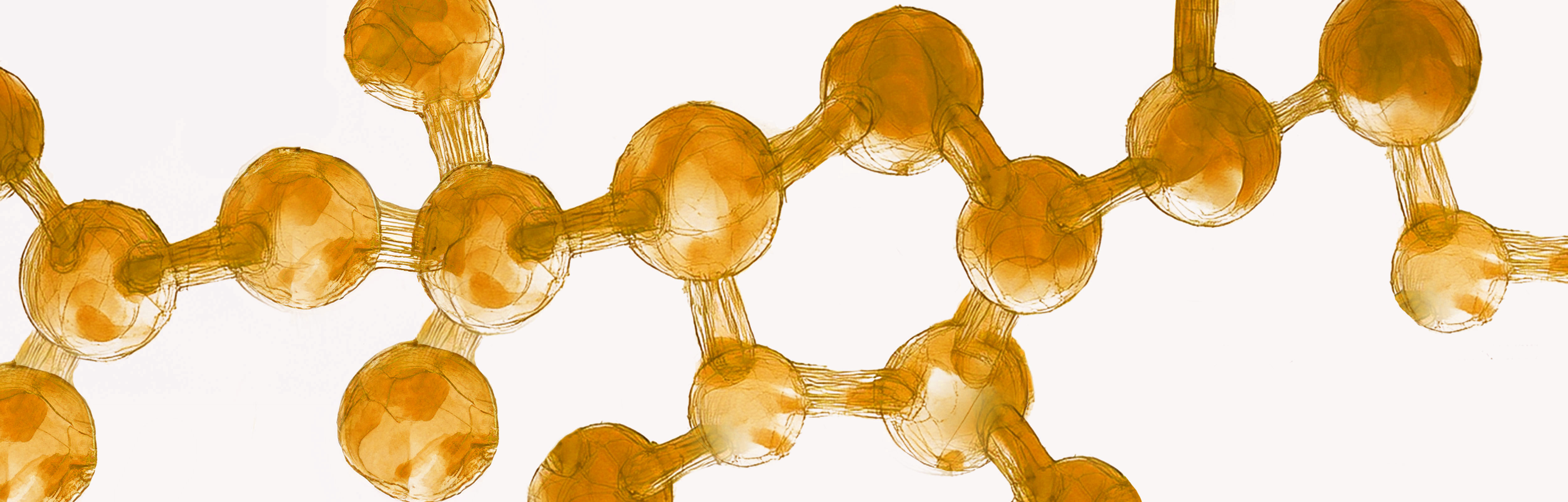
ATP: fuel for cells
Throughout the day, the body needs energy to perform multiple functions. For this, it uses a nucleotide called adenosine triphosphate (ATP), which serves as a kind of fuel for the cell, powering all its reactions (1).
During its hydrolysis, ATP releases one of its three phosphate ions for conversion into adenosine diphosphate (ADP): in doing so, it makes usable energy available to cells. In specific terms, ATP hydrolysis generates between 7 and 15 calories.
Adenosine triphosphate: a source of energy for everything!
While ATP is known mainly in the sports world, where athletes try to optimise the metabolic processes enabling its production, it’s important to understand that adenosine triphosphate is actually crucial for every function in the body.
Digestion, respiration, thermoregulation, maintaining blood concentrations, hormone production, brain function, acting on enzyme mechanisms, etc: ATP is truly multifunctional.
However, the body stores very little ATP, and thus biochemical reactions are constantly being activated to maintain ATP levels (2).
The different mechanisms of ATP synthesis
Aerobic metabolism
At rest, or during low to moderate intensity exercise when energy needs are modest, the body uses oxidation of carbohydrates and fats in the mitochondria (the cells’ ‘powerhouses’) to replenish ATP: this is ATP production by aerobic metabolism (3).
The most efficient mechanism, this can be thought of as a huge reservoir of energy with a low flow, and is therefore the best option for endurance exercise.
Lactic anaerobic metabolism
When exercise intensity reaches a moderate level, cells use glucose to produce ATP. As the intensity of the activity means greater flow rates, the pyruvate and hydrogen ions produced by glycolysis will undergo lactic fermentation, resulting in the production of lactate ions (4).
Alactic anaerobic metabolism
Finally, during short but very intense exercise (sprinting, weightlifting, etc.), it’s alactic anaerobic metabolism which is the preferred mechanism for producing ATP.
This type of metabolism relies on phosphocreatine as the ‘raw material’ for the reaction. However, the body’s phosphocreatine reserves are naturally very low which is why this system is only prioritised for intense but short bursts of exercise: think of it as a tiny reservoir with a huge flow.
Thus a key natural method of boosting ATP production is to engage in regular, moderate exercise. Endurance training (jogging, brisk walking, low-intensity cycling, etc) stimulates aerobic metabolism efficiency and enables ATP to be replenished more quickly and effectively in cells (5).
It’s also important to maintain a healthy and balanced diet sufficient to allow the body to produce ATP.
Supplements that boost ATP production
ATP capsules
For fatigue, loss of concentration and similar issues, you can take ATP capsules!
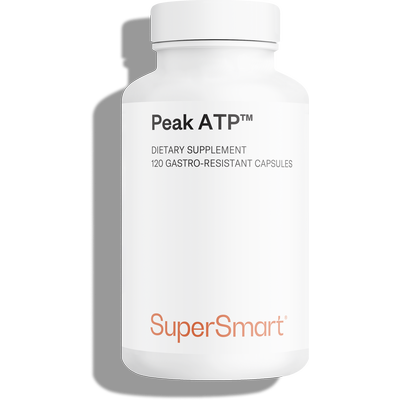
Adenosine triphosphate can actually be produced in a laboratory in a way that’s completely safe and usable by the body. So if you need to, try taking Peak ATP, a patented ATP formulation.
Creatine
The reason creatine is recognised for increasing performance during successive bursts of short, high-intensity exercise, as well as for improving the effects of resistance training on muscle strength in the over-55s, is precisely because it acts to renew ATP (6-7).
A close relative of amino acids, creatine is involved in cell energy metabolism and is primarily found in muscle and brain cells.
In cells, creatine combines first with a free phosphorus ion, and then - under the effect of the enzyme creatine kinase - this phosphorus ion combines with a molecule of ADP to form a new ATP molecule.
Effectively, therefore, creatine enables ATP to be renewed, hence its ability to increase physical performance during successive short and intense bursts of exercise: in the brief rest phases, creatine helps replenish ATP.
Creatine is therefore another excellent supplement for providing more ‘fuel’ for everyday life!
Additional supplements good for ATP production
We should also mention supplements containing D-Ribose, a major component of ATP (8). L-carnitine, meanwhile, helps transport long-chain fatty acids in the mitochondria in order to generate ATP (9). Finally, by supporting the buffering capacity of muscles and the elimination of protons, alkaline water also helps to increase ATP production (10).
SUPERSMART ADVICE
References
- https://planet-vie.ens.fr/thematiques/cellules-et-molecules/les-roles-de-l-atp
- STOCK, Daniela, GIBBONS, Clyde, ARECHAGA, Ignacio, et al.The rotary mechanism of ATP synthase. Current opinion in structural biology, 2000, vol. 10, no 6, p. 672-679.
- DUDLEY, GARY A. et TERJUNG, RONALD L. Influence of aerobic metabolism on IMP accumulation in fast-twitch muscle. American Journal of Physiology-Cell Physiology, 1985, vol. 248, no 1, p. C37-C42.
- SPRIET, Lawrence L. Anaerobic metabolism during exercise. In : Exercise metabolism. Cham : Springer International Publishing, 2022. p. 51-70.
- WIBOM, Rolf, HULTMAN, Erik, JOHANSSON, Mats, et al.Adaptation of mitochondrial ATP production in human skeletal muscle to endurance training and detraining. Journal of Applied Physiology, 1992, vol. 73, no 5, p. 2004-2010.
- MAUGHAN, Ronald J. Creatine supplementation and exercise performance. International Journal of Sport Nutrition and Exercise Metabolism, 1995, vol. 5, no 2, p. 94-101.
- HAAKE, Paul et ALLEN, Gary W. Studies on phosphorylation by phosphoroguanidinates. The mechanism of action of creatine: ATP transphosphorylase (creatine kinase). Proceedings of the National Academy of Sciences, 1971, vol. 68, no 11, p. 2691-2693.
- Pauly DF, Pepine CJ. D-Ribose as a supplement for cardiac energy metabolism. J Cardiovasc Pharmacol Ther. 2000 Oct;5(4):249-58. doi: 10.1054/JCPT.2000.18011. PMID: 11150394.
- Virmani MA, Cirulli M. The Role of l-Carnitine in Mitochondria, Prevention of Metabolic Inflexibility and Disease Initiation. Int J Mol Sci. 2022 Feb 28;23(5):2717. doi: 10.3390/ijms23052717. PMID: 35269860; PMCID: PMC8910660.
- Chycki J, Kurylas A, Maszczyk A, Golas A, Zajac A. Alkaline water improves exercise-induced metabolic acidosis and enhances anaerobic exercise performance in combat sport athletes. PLoS One. 2018 Nov 19;13(11):e0205708. doi: 10.1371/journal.pone.0205708. PMID: 30452459; PMCID: PMC6242303.
Keywords





88 Days
Fast delivery
Fast delivery, no hassle
Trusted
92 Days
Great product
Great product, quick delivery
Jamal
95 Days
Very good helps me everytime
Very good helps me everytime
TAMMINEN Liis
97 Days
it helps a lot on digestion
it helps a lot on digestion
Elisa Fleury
103 Days
Super fast delivery
Super fast delivery. Trying flexismart at the moment, Maybe a bit too soon to see results bit nice tolérance so far.
Maria Angeles Verdu
103 Days
Good service
Supersmart are an efficient company - the order arrived quickly. This is usual for them, though they have occasionally been let down by delivery firms - not a surprise and not their fault.
Barry Humphries
104 Days
Excellent product
Excellent product, quick delivery
FERENCNE Soros
106 Days
High quality, reliable service!
I have been ordering their products for years! They are excellent quality. And despite the international shipping, my order allways arrived pretty fast. The loyalty program is very fair, I get great prices on the products. Imagine: my specialists are asking me what have I been taking that my counts are so good!
Petra Hruskova
107 Days
I purchased Melatonin
I purchased Melatonin, very quick delivery to the UK and product is perfect. Very Happy
Dean Harriss
109 Days
Avis général
Well boxes are white but that puts a bit of serious color for my grey matter. Supersmart is quality products and made myself a pharmacy. Honestly should be remboursed by the health institutes selling pills
LEBORDAIS Thomas
110 Days
Arrives in just five days even to Japan…
Arrives in just five days even to Japan – that’s insanely fast! Amazing lineup of innovative products.
namio
113 Days
Quality and choice of supplements.
Quality and choice of supplements.
Maja
117 Days
perfect great
perfect great
igor janic
122 Days
Good products and speedy delivery
Good products and speedy delivery
Jim
126 Days
Very good
Very good, fast delivery
Paddy
of experience
your money back
##montant## purchase