
Cranberry supplements: what are the proven benefits of cranberries?
Cranberries have found a place in the world of dietary supplements. Discover the benefits of these tart red berries, much-prized by Native Americans.

The cranberry in botany
The cranberry (Vaccinium microcarpon) is a perennial plant from the Ericaceae family which also includes the lingonberry and the blueberry. Native to North America, it grows wild in the acid, moist soil of peaty bogs and marshes. Today, it is cultivated on a large scale in the United States(especially Wisconsin and Massachusetts) and Canada, where it is known as ‘atoca’ or ‘atoka’. In France, it is more commonly known as ‘cranberry’ or ‘large North American cranberry’ (1).
Growing to no more than 30cm in height, this evergreen, groundcover shrub is distinct from other species of the genusVaccinium in that it has small, pink, oval, open flowers which bloom in the spring.
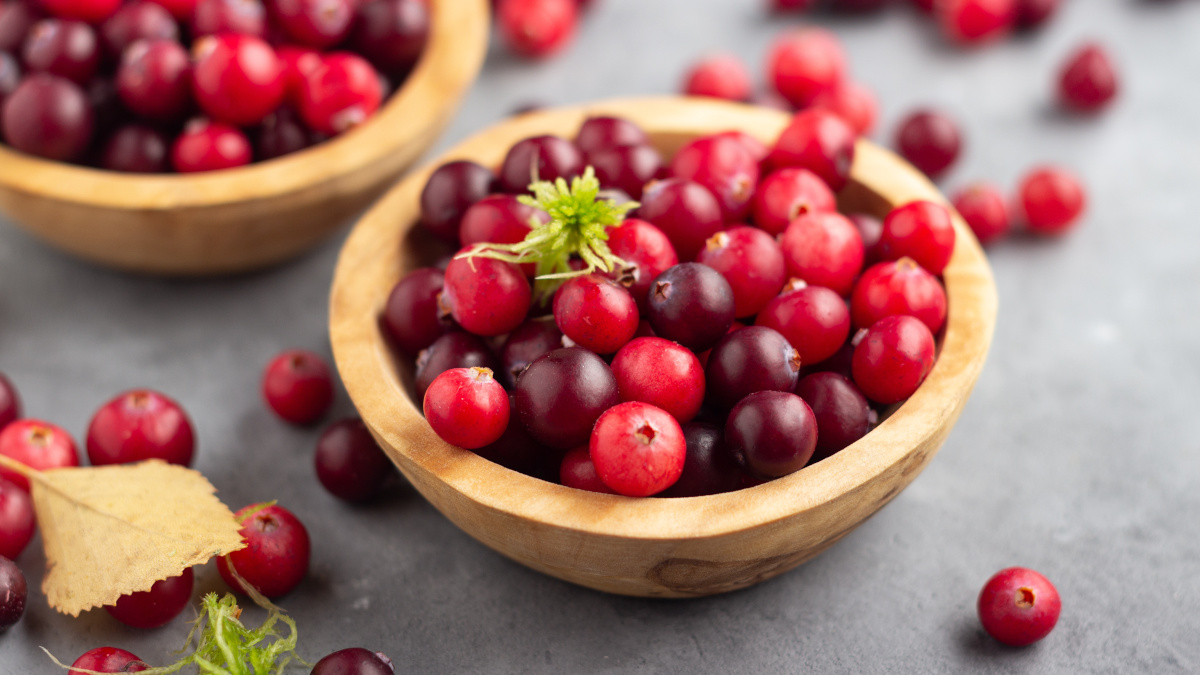
These are replaced in autumn by red berries, 2cm in diameter, with a tart, astringent flavour, which are usually consumed in the form of dried fruit, juice or jelly. Extracts of these tiny fruit are also used in the production of dietary supplements.
What health benefits are offered by cranberries?
Cranberries have a remarkable nutritional profile. The fresh berries provide a significant amount of antioxidant vitamin C (100g of raw cranberries provides 12% of our recommended daily intake) and manganese, while also being low in sugar and calories (2). The dried form has more calories, but also more fibre and vitamin E. The fruit also contains various organic acids (including citric, malic and phosphoric acids), pectin, tannin and glucosides (3).
In traditional medicine, cranberries were much prized by Native Americans for treating any condition related to the kidneys, blood and digestive system (4). They were also applied to wounds in the form of poultices or powder for their disinfecting and healing properties. However, the primary indication was for preventing and relieving urinary tract infections (5-6).
When European colonists arrived in the New World, they too came to appreciate cranberries’ many benefits. They were used, in particular, during the ‘Age of Discovery’ to combat scurvy on Atlantic voyages. Cranberry use fell out of favour after the Second World War, with the advent of synthetic antibiotics, and it was only in the early 1960s that this small red berry returned to the forefront of the scientific arena.
It was long thought that cranberries’ effects on the urinary tract were due to their acidifying action on urine. However, a totally different explanation has now been suggested. The cranberry is actually the only fruit to contain specific flavonoids called type A proanthocyanidins, which create an anti-adhesion environment hostile to bacteria (7-8).
Scientists are actively engaged in trying to confirm this theory. The results so far are generally promising. For example, one study has examined the efficacy of cranberry juice compared with a placebo in preventing recurrent urinary tract infections (UTIs) in a cohort of girls aged between 3 and 14 (9).
In a randomised controlled trial, 137 older women suffering from recurrent UTIs were given either 500mg of cranberry extract, or 100mg of an antibiotic, for a period of six months. The antibiotic was found to have only a very limited advantage over the cranberry extract in preventing recurrence (25 cases in the cranberry group and 14 in the antibiotic group), and it also had more adverse side-effects (10).
In view of their ‘anti-adhesion’ potential, cranberries are already being considered by the scientific community for other areas of application, including oral hygiene and combatting H. pylori (the most common cause of stomach ulcers) (11-12).
Innovative cranberry capsules
If you’re looking for a tried-and-tested cranberry supplement, the product Cran-Max® contains a cranberry extract supported by various clinical studies, and comes in capsule form (13). In particular, it is standardised to 7.2% type A proanthocyanidins, its most recognised active compound, for maximum efficacy.
It also benefits from the use of patented Bio Shield® technology for slow release of the active principles once they have reached the lower GI tract. This cutting-edge delivery system ensures complete and optimal absorption of the capsules’ precious substances.
Le conseil SuperSmart

References
- Neto CC, Vinson JA. Cranberry. In: Benzie IFF, Wachtel-Galor S, editors. Herbal Medicine: Biomolecular and Clinical Aspects. 2nd edition. Boca Raton (FL): CRC Press/Taylor & Francis; 2011. Chapter 6. Available from: https://www.ncbi.nlm.nih.gov/books/NBK92762/
- Nemzer BV, Al-Taher F, Yashin A, Revelsky I, Yashin Y. Cranberry: Chemical Composition, Antioxidant Activity and Impact on Human Health: Overview. 2022 Feb 23;27(5):1503. doi: 10.3390/molecules27051503. PMID: 35268605; PMCID: PMC8911768.
- Wang Y, Harrington PB, Chen P. Analysis of Phenolic Compositions in Cranberry Dietary Supplements using UHPLC-HRMS. J Food Compost Anal. 2020 Mar;86:103362. doi: 10.1016/j.jfca.2019.103362. Epub 2019 Nov 9. PMID: 32863574; PMCID: PMC7451253.
- Philip N, Walsh LJ. Cranberry Polyphenols: Natural Weapons against Dental Caries. Dent J (Basel). 2019 Mar 1;7(1):20. doi: 10.3390/dj7010020. PMID: 30823634; PMCID: PMC6473364.
- Fu Z, Liska D, Talan D, Chung M. Cranberry Reduces the Risk of Urinary Tract Infection Recurrence in Otherwise Healthy Women: A Systematic Review and Meta-Analysis. J Nutr. 2017 Dec;147(12):2282-2288. doi: 10.3945/jn.117.254961. Epub 2017 Oct 18. PMID: 29046404.
- Xia JY, Yang C, Xu DF, Xia H, Yang LG, Sun GJ. Consumption of cranberry as adjuvant therapy for urinary tract infections in susceptible populations: A systematic review and meta-analysis with trial sequential analysis. PLoS One. 2021 Sep 2;16(9):e0256992. doi: 10.1371/journal.pone.0256992. PMID: 34473789; PMCID: PMC8412316.
- Howell AB, Reed JD, Krueger CG, Winterbottom R, Cunningham DG, Leahy M. A-type cranberry proanthocyanidins and uropathogenic bacterial anti-adhesion activity. 2005 Sep;66(18):2281-91. doi: 10.1016/j.phytochem.2005.05.022. PMID: 16055161.
- Krueger CG, Reed JD, Feliciano RP, Howell AB. Quantifying and characterizing proanthocyanidins in cranberries in relation to urinary tract health. Anal Bioanal Chem. 2013 May;405(13):4385-95. doi: 10.1007/s00216-013-6750-3. Epub 2013 Feb 9. PMID: 23397091.
- Ferrara P, Romaniello L, Vitelli O, Gatto A, Serva M, Cataldi L. Cranberry juice for the prevention of recurrent urinary tract infections: a randomized controlled trial in children. Scand J Urol Nephrol. 2009;43(5):369-72. doi: 10.3109/00365590902936698. PMID: 19921981.
- McMurdo ME, Argo I, Phillips G, Daly F, Davey P. Cranberry for the prevention of recurrent urinary tract infections? A randomized controlled trial in older women. J Antimicrob Chemother. 2009 Feb;63(2):389-95. doi: 10.1093/jac/dkn489. Epub 2008 Nov 28. PMID: 19042940; PMCID: PMC2639265.
- Bodet C, Grenier D, Chandad F, Ofek I, Steinberg D, Weiss EI. Potential oral health benefits of cranberry. Crit Rev Food Sci Nutr. 2008 Aug;48(7):672-80. doi: 10.1080/10408390701636211. PMID: 18663617.
- Zhang L, Ma J, Pan K, Go VL, Chen J, You WC. Efficacy of cranberry juice on Helicobacter pylori infection: a double-blind, randomized placebo-controlled trial. 2005 Apr;10(2):139-45. doi: 10.1111/j.1523-5378.2005.00301.x. PMID: 15810945.
- Bosmans JE, Beerepoot MA, Prins JM, ter Riet G, Geerlings SE. Cost-effectiveness of cranberries vs antibiotics to prevent urinary tract infections in premenopausal women: a randomized clinical trial. PLoS One. 2014 Apr 4;9(4):e91939. doi: 10.1371/journal.pone.0091939. PMID: 24705418; PMCID: PMC3976255.





88 Days
Fast delivery
Fast delivery, no hassle
Trusted
92 Days
Great product
Great product, quick delivery
Jamal
95 Days
Very good helps me everytime
Very good helps me everytime
TAMMINEN Liis
97 Days
it helps a lot on digestion
it helps a lot on digestion
Elisa Fleury
103 Days
Super fast delivery
Super fast delivery. Trying flexismart at the moment, Maybe a bit too soon to see results bit nice tolérance so far.
Maria Angeles Verdu
103 Days
Good service
Supersmart are an efficient company - the order arrived quickly. This is usual for them, though they have occasionally been let down by delivery firms - not a surprise and not their fault.
Barry Humphries
104 Days
Excellent product
Excellent product, quick delivery
FERENCNE Soros
106 Days
High quality, reliable service!
I have been ordering their products for years! They are excellent quality. And despite the international shipping, my order allways arrived pretty fast. The loyalty program is very fair, I get great prices on the products. Imagine: my specialists are asking me what have I been taking that my counts are so good!
Petra Hruskova
107 Days
I purchased Melatonin
I purchased Melatonin, very quick delivery to the UK and product is perfect. Very Happy
Dean Harriss
109 Days
Avis général
Well boxes are white but that puts a bit of serious color for my grey matter. Supersmart is quality products and made myself a pharmacy. Honestly should be remboursed by the health institutes selling pills
LEBORDAIS Thomas
110 Days
Arrives in just five days even to Japan…
Arrives in just five days even to Japan – that’s insanely fast! Amazing lineup of innovative products.
namio
113 Days
Quality and choice of supplements.
Quality and choice of supplements.
Maja
117 Days
perfect great
perfect great
igor janic
122 Days
Good products and speedy delivery
Good products and speedy delivery
Jim
126 Days
Very good
Very good, fast delivery
Paddy
of experience
your money back
##montant## purchase