
Which probiotics should you take for constipation?
Many studies highlight the benefits of probiotics for helping to prevent or reduce constipation. But which particular probiotics should you choose?


Constipation and imbalance of the gut microbiota: a vicious circle?
When the microbiota becomes dysbiotic
Studied in detail for many years for its impact on general health and multiple diseases, the gut microbiota is one of the body’s key organs.
Composed of trillions of bacteria and as individually unique as a fingerprint, the microbiota is formed at a very early stage of development, from the first months of life, in order to achieve a symbiotic balance (1).
Problems arise when this balance is lost - when levels of certain bacteria become too low, and others too high. When such changes to the microbiota are the cause of digestive and extra-digestive diseases, it is referred to as dysbiosis.
Definition of constipation
Constipation is a gastrointestinal disorder characterised by difficulty passing stools, less frequent bowel movements or a feeling of incomplete emptying of the bowels. It can be due to a lack of fibre, fluid, physical activity, etc.
It is often accompanied by increased production of gas or bloating, caused in particular by a rise in bacterial fermentation.
To qualify as ‘chronic’, constipation must generally be present for several months.
Dysbiosis and chronic constipation may well influence each other
Unsurprisingly, studies have shown that sufferers of chronic constipation often present with dysbiosis, ie, an imbalanced gut microbiota (2). But it’s hard to know which comes first!
Current scientific knowledge suggests the two have a mutually influencing effect, creating a cycle in which:
- the dysbiosis aggravates the constipation (the imbalance in the microbiota affects intestinal motility or the absorption of nutrients);
- and the constipation aggravates the dysbiosis (the constipation slows down intestinal transit which can alter the intestinal environment and composition of its microbiota).
Probiotics and the microbiota
According to the World Health Organization (WHO), the term probiotics denotes dietary supplements that contain “live microorganisms which confer a health benefit on the host when consumed in adequate amounts” (3).
In fact, probiotics are composed of the same bacteria as those present in the microbiota. They are used for supporting the balance of the gut microbiota (4).
That’s why many studies have focused on evaluating the efficacy of probiotics, and certain strains in particular, in treating chronic constipation.
Which are the best probiotics for constipation and bloating?
Significant interest in Bifidobacterium longum
A 2017 meta-analysis, reviewing 9 randomised, placebo-controlled trials, suggests that probiotic administration significantly relieves constipation and bloating in older individuals (10%-40% of cases compared with control groups given a placebo).
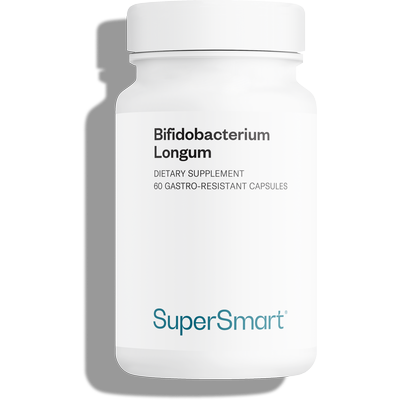
The bacterial species most often tested was Bifidobacterium longum (which can be found in the supplement Bifidobacterium longum as well as in the formulation Colon Friendly where it is combined with other synergistic bacteria) (5).
Potential benefits of Bifidobacterium lactis for constipation
Another meta-analysis, conducted in 2010, which examined 5 randomised, placebo-controlled trials involving almost 400 patients, highlights other probiotic species (6):
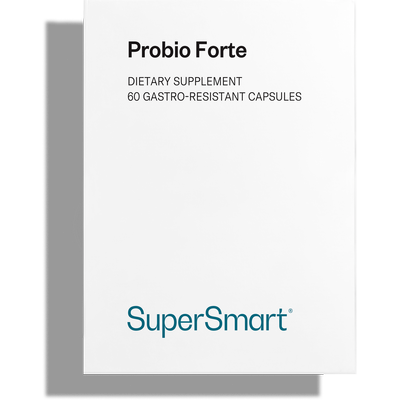
- for constipation in adults, the data suggest positive effects on bowel movement frequency and stool consistency from supplementation with Bifidobacterium lactis, Lactobacillus casei Shirota and Escherichia coliNissle 1917. You can find Bifidobacterium lactis combined synergistically with other ‘friendly bacteria’ in certain probiotic formulations (such as Probio Forte);
- for constipation in children, casei rhamnosus has shown beneficial effects.
A note on studies into constipation relief and probiotics
Caution should be exercised, however, when interpreting these reports because of the diverse nature of the studies, populations and risk of bias. All the researchers confirm the need for further placebo-controlled trials in order to identify strains, doses and optimal supplementation duration. Ultimately, however, most of the studies agree on the potential benefits of probiotics for constipation.
Probiotics for irritable bowel syndrome, in which constipation and diarrhoea can co-exist
Reminder about irritable bowel syndrome (IBS)
It’s also worth mentioning irritable bowel syndrome, which can cause constipation, diarrhoea or a combination of the two. This condition (which seems to be becoming increasingly prevalent over time, particularly among Western populations) has been a key interest in medicine for some time.
Multi-strain probiotics have the edge
A meta-analysis from 2015, examining 15 clinical trials involving almost 1800 patients, points to beneficial effects from probiotics for this condition. It concludes that, compared with a placebo, probiotics reduce pain and symptom severity in IBS (7).
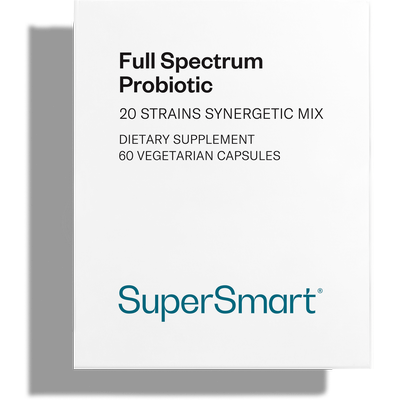
Another meta-analysis found that it was high-concentration multi-strain probiotics in particular, (such as Full Spectrum Probiotic Formula, which contains 20 strains powerfully-dosed at 36 billion CFU per day) which, by modulating the gut microbiota, may be effective in cases of IBS (8).
The yeast Saccharomyces boulardii and IBS
A meta-analysis from 2010 of 31 randomised, placebo-controlled trials involving over 5000 patients suggests that the yeast Saccharomyces boulardiioffers therapeutic efficacy in preventing diarrhoea induced by antibiotics, as well as significant potential in treating IBS in general (and thus its associated symptoms such as constipation) (9).
This probiotic is also available in dietary supplement form (see Saccharomyces Boulardii).
SUPERSMART ADVICE


References
- CARDING, Simon, VERBEKE, Kristin, VIPOND, Daniel T., et al. Dysbiosis of the gut microbiota in disease. Microbial ecology in health and disease, 2015, vol. 26, no 1, p. 26191.
- OHKUSA, Toshifumi, KOIDO, Shigeo, NISHIKAWA, Yuriko, et al. Gut microbiota and chronic constipation: a review and update. Frontiers in medicine, 2019, vol. 6, p. 19.
- MORELLI, Lorenzo et CAPURSO, Lucio. FAO/WHO guidelines on probiotics: 10 years later. Journal of clinical gastroenterology, 2012, vol. 46, p. S1-S2.
- BUTEL, M.-J. Probiotics, gut microbiota and health. Médecine et maladies infectieuses, 2014, vol. 44, no 1, p. 1-8.
- MARTÍNEZ-MARTÍNEZ, Maria Isabel, CALABUIG-TOLSÁ, Raquel, et CAULI, Omar. The effect of probiotics as a treatment for constipation in elderly people: a systematic review. Archives of Gerontology and Geriatrics, 2017, vol. 71, p. 142-149.
- CHMIELEWSKA, Anna et SZAJEWSKA, Hania. Systematic review of randomised controlled trials: probiotics for functional constipation. World journal of gastroenterology: WJG, 2010, vol. 16, no 1, p. 69.
- DIDARI, Tina, MOZAFFARI, Shilan, NIKFAR, Shekoufeh, et al. Effectiveness of probiotics in irritable bowel syndrome: Updated systematic review with meta-analysis. World journal of gastroenterology: WJG, 2015, vol. 21, no 10, p. 3072.
- BRANDT, Lawrence J., CHEY, William D., FOXX-ORENSTEIN, Amy E., et al. American college of gastroenterology task force on irritable bowel syndrome. Am J Gastroenterol, 2009, vol. 104, no Suppl 1, p. S1-S35.
- MCFARLAND, Lynne V. Systematic review and meta-analysis of Saccharomyces boulardii in adult patients. World journal of gastroenterology: WJG, 2010, vol. 16, no 18, p. 2202.


88 Days
Fast delivery
Fast delivery, no hassle
Trusted
92 Days
Great product
Great product, quick delivery
Jamal
95 Days
Very good helps me everytime
Very good helps me everytime
TAMMINEN Liis
97 Days
it helps a lot on digestion
it helps a lot on digestion
Elisa Fleury
103 Days
Super fast delivery
Super fast delivery. Trying flexismart at the moment, Maybe a bit too soon to see results bit nice tolérance so far.
Maria Angeles Verdu
103 Days
Good service
Supersmart are an efficient company - the order arrived quickly. This is usual for them, though they have occasionally been let down by delivery firms - not a surprise and not their fault.
Barry Humphries
104 Days
Excellent product
Excellent product, quick delivery
FERENCNE Soros
106 Days
High quality, reliable service!
I have been ordering their products for years! They are excellent quality. And despite the international shipping, my order allways arrived pretty fast. The loyalty program is very fair, I get great prices on the products. Imagine: my specialists are asking me what have I been taking that my counts are so good!
Petra Hruskova
107 Days
I purchased Melatonin
I purchased Melatonin, very quick delivery to the UK and product is perfect. Very Happy
Dean Harriss
109 Days
Avis général
Well boxes are white but that puts a bit of serious color for my grey matter. Supersmart is quality products and made myself a pharmacy. Honestly should be remboursed by the health institutes selling pills
LEBORDAIS Thomas
110 Days
Arrives in just five days even to Japan…
Arrives in just five days even to Japan – that’s insanely fast! Amazing lineup of innovative products.
namio
113 Days
Quality and choice of supplements.
Quality and choice of supplements.
Maja
117 Days
perfect great
perfect great
igor janic
122 Days
Good products and speedy delivery
Good products and speedy delivery
Jim
126 Days
Very good
Very good, fast delivery
Paddy
of experience
your money back
##montant## purchase