
How to consume chia seeds
Small in size, but packing quite a punch, chia seeds have burst onto the superfood scene in recent years. How should they be consumed to obtain maximum benefit from their properties?

What exactly are chia seeds?
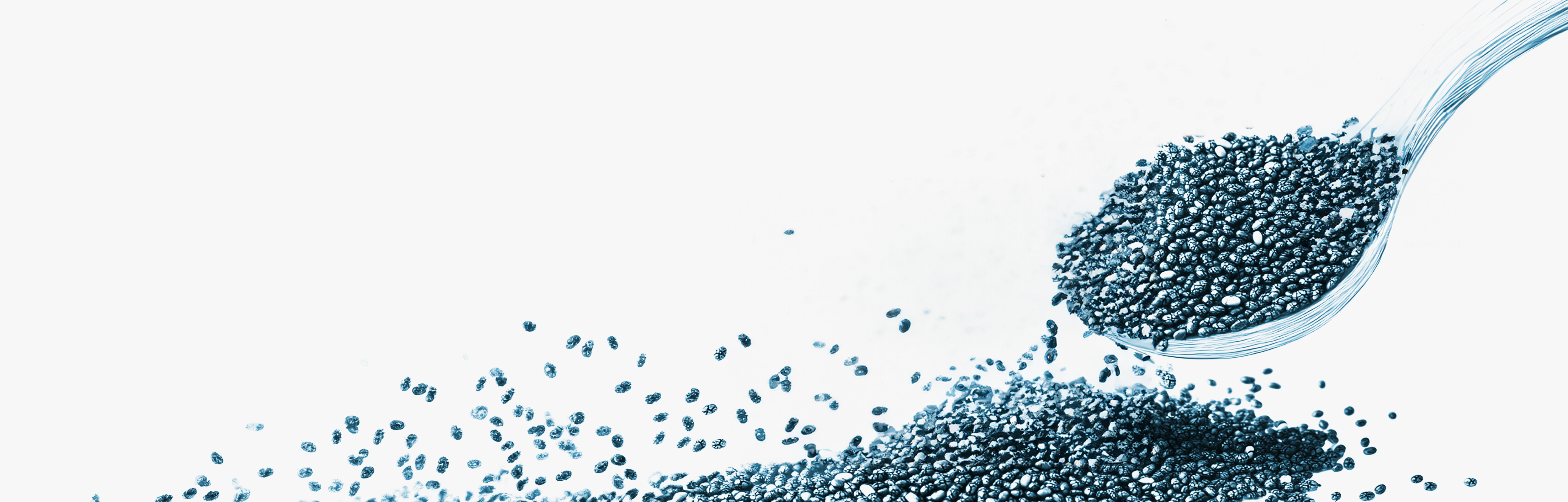
Chia seeds come from the Mexican plant Salvia hispanica, part of the Lamiaceae family which includes sage. Measuring a maximum 2mm in diameter, they have a distinct oval shape and black-to-white mottled seed casings.
What makes them distinct is their impressive hydrophilic properties relative to their tiny size: they can absorb up to 12 times their weight in water! (1)
With a long tradition of cultivation dating back to pre-Columbian Aztecs, these digestive aid seeds became a staple food throughout Mesoamerica because of their extraordinarily high nutrient content (2). Today, chia seeds are described as a ‘superfood’, and are commercially produced in several Central and South American countries, the northern United States and Australia.
What health benefits are offered by chia seeds?
These tiny seeds are abundant in nutritional benefits. Though relatively calorific (435kcal/100g), they are low in carbohydrates and high in protein (19.5g/100g). And because they contain all the essential amino acids, they are a valuable addition to vegetarian and vegan diets (3).
They also offer a near-perfect balance of omega-6 and omega-3 fatty acids (with a ratio of around 1:3, similar to that of flax seeds), numerous antioxidants, and in particular, a very high fibre content (34.4g/100g) which promotes good digestion and satiety. Last but not least, they are a valuable source of calcium, magnesium, iron and zinc (4).
For maximum benefits, it’s best to opt for organically-grown chia seeds, which are guaranteed to be free from GMOs and synthetic pesticides.
How should you consume chia seeds?
It’s perfectly possible to eat them dry
With a neutral taste, dry chia seeds can be enjoyed in a multitude of ways. They can be sprinkled, ‘as they come’, on raw vegetable salads, compotes and yogurts, where they provide a pleasant, crunchy texture. At breakfast, they can be easily added to muesli, home-made cereal bars or porridge, though for maximum nutrient uptake, it’s best to grind them first (with a coffee or spice grinder).
Hydrated chia seeds: higher uptake and a better appetite-suppressant effect
However, it’s their mucilaginous properties which make them really remarkable: when placed in liquid, they swell to form a viscous, mucilage gel. Soaking them in this way not only optimises their bioavailability – by making them more digestible and releasing their fatty acids – but it also increases their satiating effect ten-fold (5).
This makes them invaluable as an ingredient in appetite-reducing desserts (like the popular chia pudding, the perfect healthy food) and for thickening soups, smoothies and sauces. Once they’ve absorbed water or milk, they can even be used as a substitute for eggs in cake mixes (6). A truly chameleonic ingredient!
Chia seed recipes
Chia pudding
Place 2 tbsp of chia seeds in a glass, add 125-150ml of plant milk (depending on the desired consistency) and 1 tsp of honey or maple syrup (optional). Stir with a small spoon for two minutes until the seeds are evenly distributed. Refrigerate for at least 4 hours, ideally overnight. Top with slices of banana, raspberries or diced kiwi fruit and enjoy.
Chia fresca
This thirst-quenching drink from Mexico is a reinvention of summer lemonade. In a jar, mix 50cl of cold water with 1 tbsp of chia seeds, 1 tbsp of lemon juice, 1 tbsp of lime juice, a few mint leaves and 1 tbsp of agave syrup if desired. Shake well until completely mixed. Refrigerate for at least 10 minutes and drink chilled.
Vegan banana bread with chia seeds
Leave 3 tbsp of chia seeds to expand in 9 tbsp of water. Mix 150g of oat flakes with 80g of ground almonds, 1 sachet of baking powder and 1 tsp of your chosen spices (cinnamon, ginger…) Mash 3 ripe bananas with a fork and blend with 100 ml of almond milk. Pour into the dry ingredients, mix well, then lastly, add the chia seeds and 150g of cooked quinoa. Pour into a greased loaf tin. Split a banana lengthwise and arrange the two banana halves on top of the cake mix. Bake for 1 hour at 180 °C. Allow to cool before removing from the tin.
What’s a suitable daily intake of chia seeds?
To get the most out of their health virtues, it’s generally advisable to consume no more than 30g of chia seeds a day - around 2 tbsp. Consuming excessive amounts may cause digestive discomfort such as bloating or diarrhoea.
It should be noted that chia seeds are not recommended for those affected by chronic inflammatory bowel disease or allergies to other seeds. Caution is also advised if you are taking blood pressure-lowering medication or blood-thinners, as they have potentially cumulative mutual effects (8).
Going a step further: how you can boost your fibre intake
As we can see, chia seeds are, despite their excellent nutrient profile, associated with certain contra-indications. If these affect you, you can still achieve the recommended daily amount of fibre (between 25g and 35g) by using alternatives, either as a replacement or an addition.
Have you heard of fructo-oligosaccharides? Known more simply as FOS, these are a type of natural fibre found in chicory, artichokes, asparagus, bananas and garlic, and are popular mainly for their prebiotic effect, in other words, their ability to nourish the good bacteria in the microbiota (the supplement Fructo-Oligosaccharides made from beet fibre uses a natural, bioconversion process guaranteed to be GMO-free) (9).
Another compound in the same prebiotic vein is acacia gum, which contains up to 97% soluble fibre with high digestive tolerance (you can find it in the powder supplement Organic Acacia, certified organic) (10).
Carob is a fruit extracted from the pods of the Mediterranean carob tree, part of the Fabaceae family. It supports weight control by inducing a rapid feeling of satiety as a result of its galactomannan content, a type of soluble fibre which slows down gastric emptying (11). It comes in the form of both powder (as a substitute for cocoa in pastries and drinks for example), and dietary supplements (the patented carob extract CSAT is standardised to 30% galactomannans for an enhanced anti-craving effect).
SUPERSMART ADVICE


References
- Motyka S, Koc K, Ekiert H, Blicharska E, Czarnek K, Szopa A. The Current State of Knowledge on Salvia hispanica and Salviae hispanicae semen (Chia Seeds). 2022 Feb 11;27(4):1207. doi: 10.3390/molecules27041207. PMID: 35208997; PMCID: PMC8877361.
- Knez Hrnčič M, Ivanovski M, Cör D, Knez Ž. Chia Seeds (Salvia hispanica L.): An Overview-Phytochemical Profile, Isolation Methods, and Application. 2019 Dec 18;25(1):11. doi: 10.3390/molecules25010011. PMID: 31861466; PMCID: PMC6994964.
- Vera-Cespedes N, Muñoz LA, Rincón MÁ, Haros CM. Physico-Chemical and Nutritional Properties of Chia Seeds from Latin American Countries. 2023 Aug 10;12(16):3013. doi: 10.3390/foods12163013. PMID: 37628012; PMCID: PMC10453379.
- Kulczyński B, Kobus-Cisowska J, Taczanowski M, Kmiecik D, Gramza-Michałowska A. The Chemical Composition and Nutritional Value of Chia Seeds-Current State of Knowledge. 2019 May 31;11(6):1242. doi: 10.3390/nu11061242. PMID: 31159190; PMCID: PMC6627181.
- Zare T, Rupasinghe TWT, Boughton BA, Roessner U. The changes in the release level of polyunsaturated fatty acids (ω-3 and ω-6) and lipids in the untreated and water-soaked chia seed. Food Res Int. 2019 Dec;126:108665. doi: 10.1016/j.foodres.2019.108665. Epub 2019 Sep 10. PMID: 31732052.
- Karpińska-Tymoszczyk M, Danowska-Oziewicz M, Draszanowska A. Effect of the Addition of Chia Seed Gel as Egg Replacer and Storage Time on the Quality of Pork Patties. 2021 Jul 29;10(8):1744. doi: 10.3390/foods10081744. PMID: 34441522; PMCID: PMC8391748.
- Dickens B, Sassanpour M, Bischoff EL. The Effect of Chia Seeds on High-Density Lipoprotein (HDL) Cholesterol. 2023 Jun 13;15(6):e40360. doi: 10.7759/cureus.40360. PMID: 37456479; PMCID: PMC10339661.
- Ozón B, Cotabarren J, Valicenti T, Graciela Parisi M, David Obregón W. Chia expeller: A promising source of antioxidant, antihypertensive and antithrombotic peptides produced by enzymatic hydrolysis with Alcalase and Flavourzyme. Food Chem. 2022 Jun 30;380:132185. doi: 10.1016/j.foodchem.2022.132185. Epub 2022 Jan 19. PMID: 35093662.
- Sabater-Molina M, Larqué E, Torrella F, Zamora S. Dietary fructooligosaccharides and potential benefits on health. J Physiol Biochem. 2009 Sep;65(3):315-28. doi: 10.1007/BF03180584. PMID: 20119826.
- Elnour AAM, Abdurahman NH, Musa KH, Rasheed Z. Prebiotic potential of gum Arabic for gut health. Int J Health Sci (Qassim). 2023 Nov-Dec;17(6):4-5. PMID: 37929233; PMCID: PMC10624802.
- Rašković A, Martić N, Tomas A, Andrejić-Višnjić B, Bosanac M, Atanasković M, Nemet M, Popović R, Krstić M, Vukmirović S, Stilinović N. Carob Extract (Ceratonia siliqua L.): Effects on Dyslipidemia and Obesity in a High-Fat Diet-Fed Rat Model. 2023 Nov 10;15(11):2611. doi: 10.3390/pharmaceutics15112611. PMID: 38004588; PMCID: PMC10674595.
Keywords




88 Days
Fast delivery
Fast delivery, no hassle
Trusted
92 Days
Great product
Great product, quick delivery
Jamal
95 Days
Very good helps me everytime
Very good helps me everytime
TAMMINEN Liis
97 Days
it helps a lot on digestion
it helps a lot on digestion
Elisa Fleury
103 Days
Super fast delivery
Super fast delivery. Trying flexismart at the moment, Maybe a bit too soon to see results bit nice tolérance so far.
Maria Angeles Verdu
103 Days
Good service
Supersmart are an efficient company - the order arrived quickly. This is usual for them, though they have occasionally been let down by delivery firms - not a surprise and not their fault.
Barry Humphries
104 Days
Excellent product
Excellent product, quick delivery
FERENCNE Soros
106 Days
High quality, reliable service!
I have been ordering their products for years! They are excellent quality. And despite the international shipping, my order allways arrived pretty fast. The loyalty program is very fair, I get great prices on the products. Imagine: my specialists are asking me what have I been taking that my counts are so good!
Petra Hruskova
107 Days
I purchased Melatonin
I purchased Melatonin, very quick delivery to the UK and product is perfect. Very Happy
Dean Harriss
109 Days
Avis général
Well boxes are white but that puts a bit of serious color for my grey matter. Supersmart is quality products and made myself a pharmacy. Honestly should be remboursed by the health institutes selling pills
LEBORDAIS Thomas
110 Days
Arrives in just five days even to Japan…
Arrives in just five days even to Japan – that’s insanely fast! Amazing lineup of innovative products.
namio
113 Days
Quality and choice of supplements.
Quality and choice of supplements.
Maja
117 Days
perfect great
perfect great
igor janic
122 Days
Good products and speedy delivery
Good products and speedy delivery
Jim
126 Days
Very good
Very good, fast delivery
Paddy
of experience
your money back
##montant## purchase