
5 foods to eat if you have low serum folate
Essential for the formation of red blood cells, folate (vitamin B9) plays a key role in many biological mechanisms. Here are the main causes of low serum folate levels and 5 foods to choose.


What is vitamin B9 (folate and folic acid)?
Vitamin B9 is a water-soluble vitamin that helps to reduce fatigue.
It exists in several forms:
- folate (natural form): found in green vegetables, legumes and certain other foods
- folic acid (synthetic form): used in food supplements and fortified foods
In the body, these different forms are converted into 5-methyl-tetrahydrofolate (5-MTHF), the biologically active form of vitamin B9 that circulates in the blood and penetrates cells.
Why is folate important for health?
Folate plays a central role in many essential biological mechanisms. In particular, it contributes to:
- the growth of maternal tissues during pregnancy
- the normal synthesis of amino acids
- normal blood formation
- the normal metabolism of homocysteine
- normal psychological functions
- the normal functioning of the immune system
- the reduction of fatigue
- normal cell division – essential for tissue renewal
These functions are based on well-established biological mechanisms.
Maternal tissue growth is linked to folate's role in cell division, which is essential for embryonic and foetal development.
Its contribution to amino acid synthesis enables the production of proteins required for the body's metabolic functions.
The formation of blood and the reduction of fatigue are linked to the role of folate in the production of red blood cells, which are essential for oxygen transport.
Folate is also involved in the transformation of homocysteine into methionine, an important process in the normal functioning of the metabolism.
Finally, its involvement in normal psychological functions is explained by its indirect role in the synthesis of certain biological mediators necessary for the proper functioning of the nervous system.
Some observational studies also suggest a link between adequate folate intake and markers of brain health during the ageing process (1). However, these results remain exploratory and do not constitute proof of a preventive effect.
When should serum folate levels be measured?
Serum folate measurement is useful in a number of situations, particularly to investigate anaemia or to understand unexplained persistent fatigue.
A folate deficiency may be responsible for symptoms such as fatigue, paleness, shortness of breath and palpitations. It may also be accompanied by more discreet symptoms such as digestive problems, mood swings or reduced concentration.
This blood test is particularly relevant in cases of intestinal malabsorption, as well as for the elderly, those who are malnourished or individuals who regularly consume alcohol.
For pregnant women or women who want to become pregnant, it can be used to check that their intake is sufficient to support cell division and blood formation.
Taking certain medications – such as anticonvulsants or, more rarely, oral contraceptives – may also justify this test.
A study of 27,758 women of childbearing age in Korea showed that 5.4% had a serum folate deficiency at a threshold < 3 ng/mL (2), underlining the value of this test in at-risk populations.
What threshold is considered low?
Low serum folate is generally defined as a value of less than 3 ng/mL, although the thresholds for normality may vary slightly from one laboratory to another.
In France, data from the Esteban study (2014-2016) highlight a significant prevalence of folate deficiency in women of childbearing age (3).
In this study:
- 13.4% of women aged 18 to 49 had serum folate levels < 3 ng/mL
- 0.6% of adolescent girls aged 15 to 17 showed similarly low serum folate levels
According to ANSES, this proportion was 7.2% in 2006, indicating a gradual deterioration in folate status among adult women over the following decade.
These results underline the importance of a reinforced prevention strategy, based on a diet rich in green vegetables, legumes and fruit, and on systematic folic acid supplementation during the periconceptional period.
5 foods to choose in cases of low serum folate
To support your vitamin B9 intake, certain foods are particularly rich in folate and easy to incorporate into your daily routine.
1. Lentils
Lentils are one of the best vegetable sources of folate, with an average intake of around 180 µg per 100 g cooked.
To preserve this fragile vitamin, it is advisable to cook them gently (20 to 25 minutes) and, if possible, to reuse the cooking water in a soup or casserole: as folate is water-soluble, it leaches easily into water.
2. Spinach
Spinach is very rich in folate, with around 190 µg per 100 g when raw.
It can easily be added to your daily diet, raw in a salad or very lightly fried to limit losses. It's best to avoid cooking it in water for a long time, as this causes significant degradation of vitamin B9.
3. Avocados
Avocados provide around 80 µg of folate per 100 g.
Eaten raw, they help preserve vitamin B9. They can be eaten on toast, in salads or as a cold purée, to limit oxidation and maximise folate intake.
4. Citrus fruits
Citrus fruits, such as oranges, lemons and grapefruit, provide between 30 and 50 µg of folate per 100 g. They provide folate while contributing to a varied diet rich in micronutrients.
It is preferable to eat fruit whole rather than in juice, to preserve fibre and nutrients.
5. Eggs yolks
A notable source, egg yolks contain around 45 µg of folate per 100 g.
To preserve its vitamin B9 content, opt for gentle cooking: soft-boiled, medium-boiled or poached eggs.
Even with a balanced diet, some folate can be destroyed during cooking, as this vitamin is very sensitive to air, heat and water.
One study has shown that cooking spinach or green beans leads to rapid degradation of folate in the presence of oxygen, whereas losses are much lower in air-free conditions (4).
Vitamin B9: what supplements are needed for low serum folate?
Not all sources of B9 are assimilated in the same way.
Folic acid, widely used in supplements, must first be converted by the body into the active form of vitamin B9 – a step that may be less effective in some people.
In contrast, 5-methyltetrahydrofolate (5-MTHF), also known as L-methylfolate, is the biologically active form that circulates in the body. It can be used directly, without any transformation step.
A pharmacokinetic review confirmed that L-5-methyltetrahydrofolate has a bioavailability equal to or greater than that of folic acid, making it a more directly usable form in the body (5).
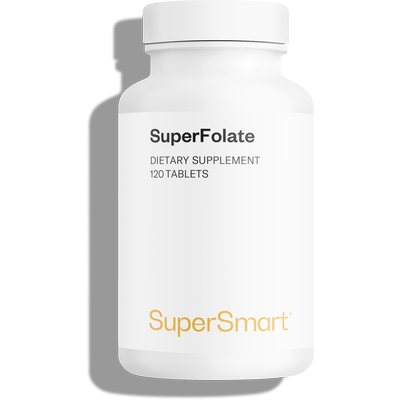
Quatrefolic®, a patented form of 5-MTHF, was authorised in the European Union in 2014 following a favourable opinion from EFSA (2013), and initial approval by the FDA in 2010.
Discover SuperFolate, a highly bioavailable folate supplement using the active form Quatrefolic®.
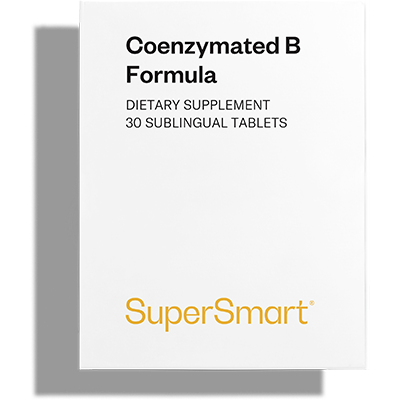
Vitamin B9 is also used in the composition of broader multivitamin complexes, particularly in sublingual formulas: these allow partial absorption via the buccal mucosa, which may be of interest to people with digestive problems.
Discover Coenzymated B Vitamins, a complex of B vitamins in coenzyme form, packaged in sublingual tablets.
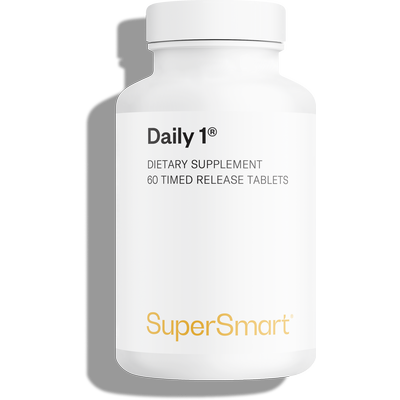
Finally, sustained-release formulas allow micronutrients to be released gradually over the course of the day.
Discover Daily 1, a formula containing 30 exceptional vitamins, minerals and compounds, designed to release their content over an extended period.
SUPERSMART ADVICE
References
- Corrada MM, Kawas CH, Hallfrisch J, Muller D, Brookmeyer R. Reduced risk of Alzheimer's disease with high folate intake: the Baltimore Longitudinal Study of Aging. Alzheimers Dement. 2005 Jul;1(1):11-8. doi: 10.1016/j.jalz.2005.06.001. PMID: 19595811; PMCID: PMC3375831.
- R. Choi et al., The Utilization of Serum Folate and Homocysteine Tests and the Prevalence of Folate Deficiency in Reproductive‑Age Korean Women, Nutrients, vol. 15, 2023, doi:10.3390/nu15143224.
- https://www.santepubliquefrance.fr/les-actualites/2019/esteban-2014-2016-chapitre-dosages-biologiques-des-vitamines-et-mineraux-pas-de-deficit-important-ou-de-carence-a-grande-echelle
- Delchier N, Ringling C, Cuvelier ME, Courtois F, Rychlik M, Renard CM. Thermal degradation of folates under varying oxygen conditions. Food Chem. 2014 Dec 15;165:85-91. doi: 10.1016/j.foodchem.2014.05.076. Epub 2014 May 23. PMID: 25038652.
- Shane, B., Bailey, L., & Pietrzik, K. (2010). Folic Acid and L-5-Methyltetrahydrofolate: Comparison of Clinical Pharmacokinetics and Pharmacodynamics. Clinical Pharmacokinetics, 49(8), 535–548. https://doi.org/10.2165/11532990-000000000-00000





88 Days
Fast delivery
Fast delivery, no hassle
Trusted
92 Days
Great product
Great product, quick delivery
Jamal
95 Days
Very good helps me everytime
Very good helps me everytime
TAMMINEN Liis
97 Days
it helps a lot on digestion
it helps a lot on digestion
Elisa Fleury
103 Days
Super fast delivery
Super fast delivery. Trying flexismart at the moment, Maybe a bit too soon to see results bit nice tolérance so far.
Maria Angeles Verdu
103 Days
Good service
Supersmart are an efficient company - the order arrived quickly. This is usual for them, though they have occasionally been let down by delivery firms - not a surprise and not their fault.
Barry Humphries
104 Days
Excellent product
Excellent product, quick delivery
FERENCNE Soros
106 Days
High quality, reliable service!
I have been ordering their products for years! They are excellent quality. And despite the international shipping, my order allways arrived pretty fast. The loyalty program is very fair, I get great prices on the products. Imagine: my specialists are asking me what have I been taking that my counts are so good!
Petra Hruskova
107 Days
I purchased Melatonin
I purchased Melatonin, very quick delivery to the UK and product is perfect. Very Happy
Dean Harriss
109 Days
Avis général
Well boxes are white but that puts a bit of serious color for my grey matter. Supersmart is quality products and made myself a pharmacy. Honestly should be remboursed by the health institutes selling pills
LEBORDAIS Thomas
110 Days
Arrives in just five days even to Japan…
Arrives in just five days even to Japan – that’s insanely fast! Amazing lineup of innovative products.
namio
113 Days
Quality and choice of supplements.
Quality and choice of supplements.
Maja
117 Days
perfect great
perfect great
igor janic
122 Days
Good products and speedy delivery
Good products and speedy delivery
Jim
126 Days
Very good
Very good, fast delivery
Paddy
of experience
your money back
##montant## purchase