
What acidic foods should you avoid?
Deacidifying your body means reviewing the content of your plate. Which acidic foods should be avoided or limited?


Acidification of the body: why are we more exposed?
The concept of acidification of the body refers to the notion of acid-alkaline balance, itself linked to our blood pH value.
This numerical measurement, ranging from 0 to 14, assesses the acid load in our blood: below 7, it is acidic; around 7, it is neutral; above 7, it is basic or alkaline.
For our bodies to function properly, our blood pH should be slightly alkaline (between 7.35 and 7.45) (1). Natural buffer systems limit variations in pH by neutralising fluctuations in H⁺ ions. This is mainly maintained by the lungs and kidneys, with secondary assistance from the liver and muscles (2).
However, our natural buffer systems (the lungs and kidneys) are under greater strain as a result of the way we live today. Our modern diet, for example, favours meat and ultra-processed products to the detriment of plant-based ones. Other contributing factors include excessive alcohol consumption, chronic stress, a sedentary lifestyle and advancing age. This functional overload can have metabolic consequences, such as increased acid excretion by the kidneys or mineral imbalances. This could contribute to a metabolic state sometimes described as chronic low-grade acidosis (3-4).
What are the risks of chronic acidosis?
A number of researchers and naturopaths are currently considering chronic acidosis as a serious possibility to explain the resurgence of certain chronic disorders and conditions, ranging from heartburn and acid reflux to muscle and joint pain and various inflammations, as well as certain renal and cardiovascular dysfunctions (such as high blood pressure) (5).
Excessive acid load is also thought to increase the risk of osteoporosis (6). Why would this be? To counteract an excessive acid load, our bodies are forced to draw alkalinising substances such as citrates and bicarbonates directly from our bones. However, these substances are bound to calcium ions, forcing us to draw on our calcium reserves and consequently reduce our bone density.
The list of acidic foods
The acidifying or alkalinising potential of a food can be roughly estimated using its PRAL (Potential Renal Acid Load) index (7).
It can be interpreted simply: foods with a positive PRAL are acidic, while those with a negative PRAL are alkaline. The further the score is from zero, the more pronounced the effect. For example, cucumber has a PRAL index of -5 (it is alkalinising) while cooked beef has a PRAL index of +14 (it is acidifying).
We can quickly see that certain food groups have a more marked acidifying effect.
Salt (and salted products)
Table salt and all products containing it, such as cold meats, bread, cheese, crisps and ready-made meals, are thought to acidify the body and hasten the loss of bone calcium (8).
We are therefore strongly advised to add less salt to our dishes (and especially not to re-salt them routinely) and to limit all sources of 'hidden salt', as already recommended by health authorities as part of their efforts to prevent cardiovascular disease.
Meat products
While meat products provide good quality protein, their sulphur-containing amino acids are converted into acidifying sulphuric acid (9).
For example, a fried egg has a PRAL index of +7.9, prawns +10.1, ham +12.2 and veal escalope +18.7. Without eliminating them completely, it is advisable to restrict yourself to one portion a day when you are trying to deacidify your body.
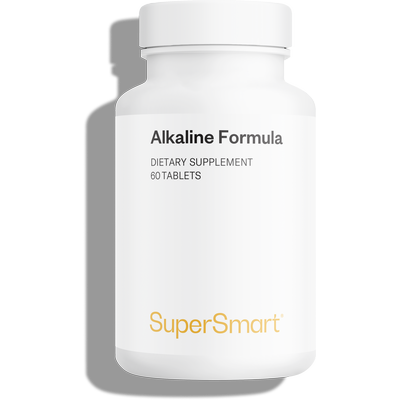
Having trouble reducing your meat intake? At least try to redress the balance by boosting your intake of alkaline minerals (magnesium, calcium and potassium in particular) and/or by relying on plant extracts such as ginger, the flagship rhizome of Ayurvedic medicine with a PRAL index of less than -6 (all combined in the synergistic Alkaline Formula, which also contains various promising compounds for regulating acid-base balance, such as liquorice root, which supports digestion and metabolic health) (10-12).
Cheeses
With a PRAL index of around +20 on average (and up to +34 for Parmesan!), cheeses are among the most acidifying foods available (13).
Here again, a portion of 30 to 40g a day is reasonable, with a preference for those that have the least impact on acid-base balance, such as Camembert, Saint-Nectaire or Roquefort (around +13).
Milk and yoghurts, on the other hand, have a fairly neutral effect and are therefore to be preferred.
Some cereals
The starchy foods family also includes some acidifying agents.
While rice and pasta have a PRAL index fairly close to neutral, those of bread products, spelt, rye and oat flakes are higher.
It would be better to replace them more often with legumes, which have little or no effect on our body's acid load.
Some seeds and nuts
Despite their richness in alkalising minerals (particularly magnesium), some oily seeds and nuts tend to increase the body's acid load because of their high protein content (14).
This is the case with cashew nuts, Brazil nuts and sunflower seeds. And if they're roasted, it's even worse. Notably, only the hazelnut and the macadamia nut are alkalising.
To boost your plant protein intake without affecting your acidity levels, why not turn to Spirulina? It's a remineralising micro-alga that is a source of magnesium, calcium and potassium (the Spirulina supplement comes from drastically controlled aquaculture, which guarantees safe supplementation, unlike other sources contaminated with pollutants and heavy metals) (15).
Soft drinks
Soft drinks (particularly cola-based drinks) contain phosphoric acid, a particularly acidifying agent.
While it's best to stick to tap water, which is generally in a neutral pH range, alkaline waters (such as SuperWater, with a high sodium chloride and hydroxide content) are a useful addition to hydration as part of an acid-alkaline rebalancing programme (16).
But beware: a food with an acidic taste is not necessarily acidifying... and vice versa! The best example is citrus fruit (lemon, orange, grapefruit) which, despite their acidic flavour, are actually alkalinising.
What basic foods should I choose?
Fruit and vegetables are the mainstays of an alkalinising diet (17). And with good reason: they are packed with potassium, which has a strong alkalizing effect. Among the most beneficial are bananas, green leafy vegetables, celery and dried apricots.
Another good idea is to sprinkle spices (turmeric, cinnamon, etc.) and fresh herbs (thyme, parsley, etc.) over your dishes, or drink green tea instead of coffee (18-19).
To find out more, take a look at our detailed article on the subject: What are the best basic foods?
SUPERSMART ADVICE
References
- Hopkins E, Sanvictores T, Sharma S. Physiology, Acid Base Balance. [Updated 2022 Sep 12]. In: StatPearls [Internet]. Treasure Island (FL): StatPearls Publishing; 2024 Jan-. Available from: https://www.ncbi.nlm.nih.gov/books/NBK507807/
- Hamm LL, Nakhoul N, Hering-Smith KS. Acid-Base Homeostasis. Clin J Am Soc Nephrol. 2015 Dec 7;10(12):2232-42. doi: 10.2215/CJN.07400715. Epub 2015 Nov 23. PMID: 26597304; PMCID: PMC4670772.
- Remer T. Influence of diet on acid-base balance. Semin Dial. 2000 Jul-Aug;13(4):221-6. doi: 10.1046/j.1525-139x.2000.00062.x. PMID: 10923348.
- Epstein M. Alcohol's impact on kidney function. Alcohol Health Res World. 1997;21(1):84-92. PMID: 15706766; PMCID: PMC6826793.
- DiNicolantonio JJ, O'Keefe J. Low-grade metabolic acidosis as a driver of chronic disease: a 21st century public health crisis. Open Heart. 2021 Oct;8(2):e001730. doi: 10.1136/openhrt-2021-001730. PMID: 34702776; PMCID: PMC8549658.
- Bonjour JP. Nutritional disturbance in acid-base balance and osteoporosis: a hypothesis that disregards the essential homeostatic role of the kidney. Br J Nutr. 2013 Oct;110(7):1168-77. doi: 10.1017/S0007114513000962. Epub 2013 Apr 4. PMID: 23551968; PMCID: PMC3828631.
- Osuna-Padilla IA, Leal-Escobar G, Garza-García CA, Rodríguez-Castellanos FE. Dietary Acid Load: mechanisms and evidence of its health repercussions. Nefrologia (Engl Ed). 2019 Jul-Aug;39(4):343-354. English, Spanish. doi: 10.1016/j.nefro.2018.10.005. Epub 2019 Feb 5. PMID: 30737117.
- Teucher B, Dainty JR, Spinks CA, Majsak-Newman G, Berry DJ, Hoogewerff JA, Foxall RJ, Jakobsen J, Cashman KD, Flynn A, Fairweather-Tait SJ. Sodium and bone health: impact of moderately high and low salt intakes on calcium metabolism in postmenopausal women. J Bone Miner Res. 2008 Sep;23(9):1477-85. doi: 10.1359/jbmr.080408. PMID: 18410231.
- Herter J, Lederer AK, Ronco AL, Hannibal L, Huber R, Storz MA. Dietary Acid Load Correlates with Serum Amino Acid Concentrations after a Four-Week Intervention with Vegan vs. Meat-Rich Diets: A Secondary Data Analysis. 2023 Jun 28;15(13):2942. doi: 10.3390/nu15132942. PMID: 37447267; PMCID: PMC10343925.
- König D, Muser K, Dickhuth HH, Berg A, Deibert P. Effect of a supplement rich in alkaline minerals on acid-base balance in humans. Nutr J. 2009 Jun 10;8:23. doi: 10.1186/1475-2891-8-23. PMID: 19515242; PMCID: PMC2702352.
- Modi M, Modi K. Ginger Root. [Updated 2024 Aug 11]. In: StatPearls [Internet]. Treasure Island (FL): StatPearls Publishing; 2024 Jan-. Available from: https://www.ncbi.nlm.nih.gov/books/NBK565886/
- Pastorino G, Cornara L, Soares S, Rodrigues F, Oliveira MBPP. Liquorice (Glycyrrhiza glabra): A phytochemical and pharmacological review. Phytother Res. 2018 Dec;32(12):2323-2339. doi: 10.1002/ptr.6178. Epub 2018 Aug 17. PMID: 30117204; PMCID: PMC7167772.
- Rodrigues Neto Angéloco L, Arces de Souza GC, Almeida Romão E, Garcia Chiarello P. Alkaline Diet and Metabolic Acidosis: Practical Approaches to the Nutritional Management of Chronic Kidney Disease. J Ren Nutr. 2018 May;28(3):215-220. doi: 10.1053/j.jrn.2017.10.006. Epub 2017 Dec 6. PMID: 29221627.
- Gonçalves B, Pinto T, Aires A, Morais MC, Bacelar E, Anjos R, Ferreira-Cardoso J, Oliveira I, Vilela A, Cosme F. Composition of Nuts and Their Potential Health Benefits-An Overview. 2023 Feb 23;12(5):942. doi: 10.3390/foods12050942. PMID: 36900459; PMCID: PMC10000569.
- Koli DK, Rudra SG, Bhowmik A, Pabbi S. Nutritional, Functional, Textural and Sensory Evaluation of Spirulina Enriched Green Pasta: A Potential Dietary and Health Supplement. 2022 Mar 28;11(7):979. doi: 10.3390/foods11070979. PMID: 35407065; PMCID: PMC8997815.
- Chan YM, Shariff ZM, Chin YS, Ghazali SS, Lee PY, Chan KS. Associations of alkaline water with metabolic risks, sleep quality, muscle strength: A cross-sectional study among postmenopausal women. PLoS One. 2022 Oct 31;17(10):e0275640. doi: 10.1371/journal.pone.0275640. PMID: 36315555; PMCID: PMC9621423.
- Wieërs MLAJ, Beynon-Cobb B, Visser WJ, Attaye I. Dietary acid load in health and disease. Pflugers Arch. 2024 Apr;476(4):427-443. doi: 10.1007/s00424-024-02910-7. Epub 2024 Jan 29. PMID: 38282081; PMCID: PMC11006742.
- Opara EI, Chohan M. Culinary herbs and spices: their bioactive properties, the contribution of polyphenols and the challenges in deducing their true health benefits. Int J Mol Sci. 2014 Oct 22;15(10):19183-202. doi: 10.3390/ijms151019183. PMID: 25340982; PMCID: PMC4227268.
- Chacko SM, Thambi PT, Kuttan R, Nishigaki I. Beneficial effects of green tea: a literature review. Chin Med. 2010 Apr 6;5:13. doi: 10.1186/1749-8546-5-13. PMID: 20370896; PMCID: PMC2855614.
Keywords






88 Days
Fast delivery
Fast delivery, no hassle
Trusted
92 Days
Great product
Great product, quick delivery
Jamal
95 Days
Very good helps me everytime
Very good helps me everytime
TAMMINEN Liis
97 Days
it helps a lot on digestion
it helps a lot on digestion
Elisa Fleury
103 Days
Super fast delivery
Super fast delivery. Trying flexismart at the moment, Maybe a bit too soon to see results bit nice tolérance so far.
Maria Angeles Verdu
103 Days
Good service
Supersmart are an efficient company - the order arrived quickly. This is usual for them, though they have occasionally been let down by delivery firms - not a surprise and not their fault.
Barry Humphries
104 Days
Excellent product
Excellent product, quick delivery
FERENCNE Soros
106 Days
High quality, reliable service!
I have been ordering their products for years! They are excellent quality. And despite the international shipping, my order allways arrived pretty fast. The loyalty program is very fair, I get great prices on the products. Imagine: my specialists are asking me what have I been taking that my counts are so good!
Petra Hruskova
107 Days
I purchased Melatonin
I purchased Melatonin, very quick delivery to the UK and product is perfect. Very Happy
Dean Harriss
109 Days
Avis général
Well boxes are white but that puts a bit of serious color for my grey matter. Supersmart is quality products and made myself a pharmacy. Honestly should be remboursed by the health institutes selling pills
LEBORDAIS Thomas
110 Days
Arrives in just five days even to Japan…
Arrives in just five days even to Japan – that’s insanely fast! Amazing lineup of innovative products.
namio
113 Days
Quality and choice of supplements.
Quality and choice of supplements.
Maja
117 Days
perfect great
perfect great
igor janic
122 Days
Good products and speedy delivery
Good products and speedy delivery
Jim
126 Days
Very good
Very good, fast delivery
Paddy
of experience
your money back
##montant## purchase